Proxy billing
Open Source IPv4 & IPv6 proxy billing software
NexCMP is self-hosted proxy billing and management software for operators who run their own nodes and IP addresses. It manages nodes, plans, quotas and a prepaid wallet with invoices, and gives customers a portal on your domain to buy, renew and export proxies.
The VPN and IPv6 Proxy modules are part of NexCMP and cost nothing extra. They are switched off until you turn them on. You bring the nodes and the IP addresses; NexCMP does not supply IPs, bandwidth or an IP network.NexCMP Source: full source code for $499, one-time. Use, modify and self-host for your own business. You may sell the services you operate; you may not resell or redistribute the source code or builds. Source license terms


What is NexCMP proxy billing?
NexCMP sits between your proxy nodes and your customers. A small agent on each Linux server that holds your IPs lets NexCMP turn those addresses into products with prices, sell them through a portal, charge a prepaid wallet, issue invoices and renew or end the service on time.
The proxy ports run on your own servers, on your own IPs. NexCMP has no network of its own and no pool of addresses.
How your customers manage proxies
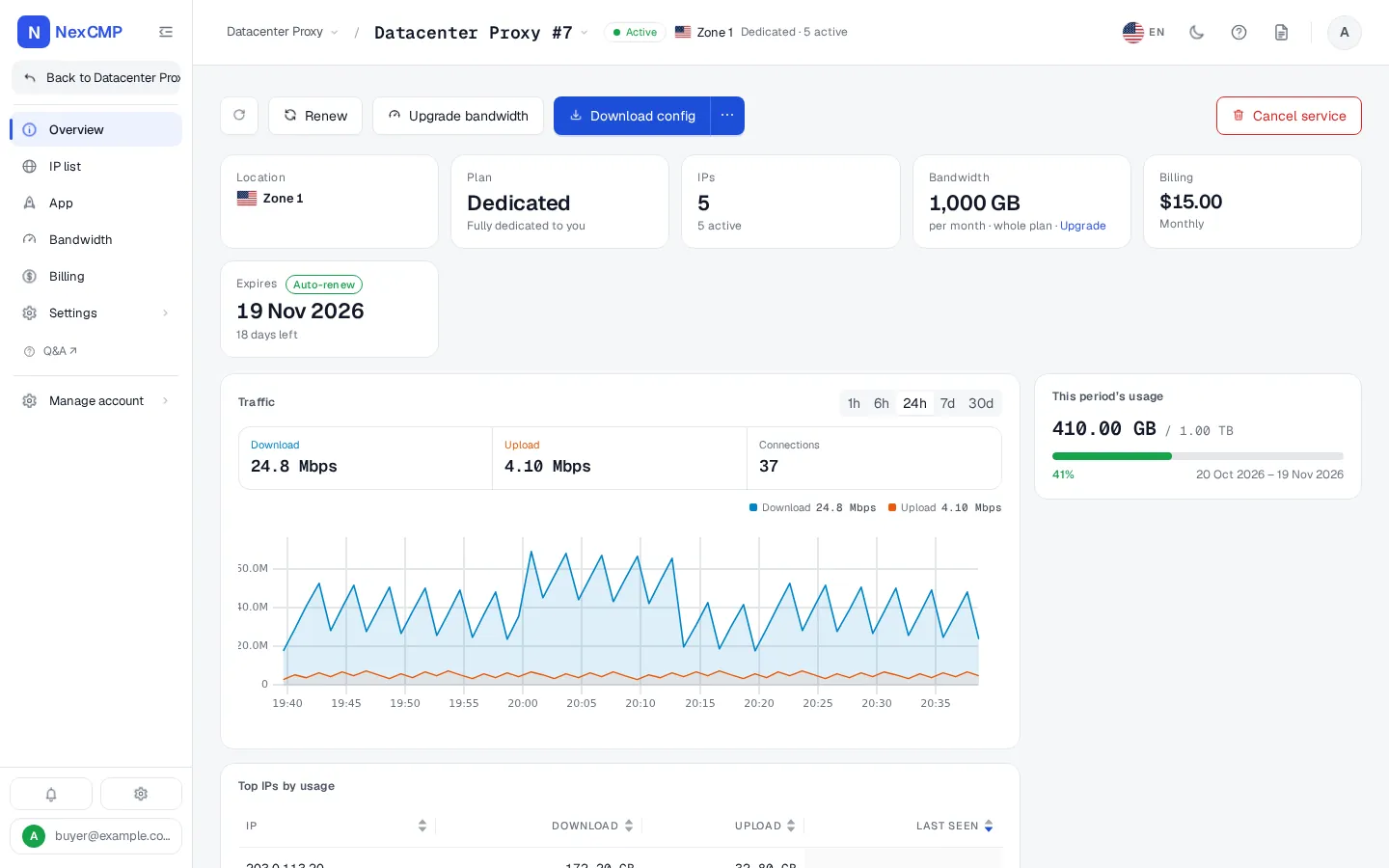
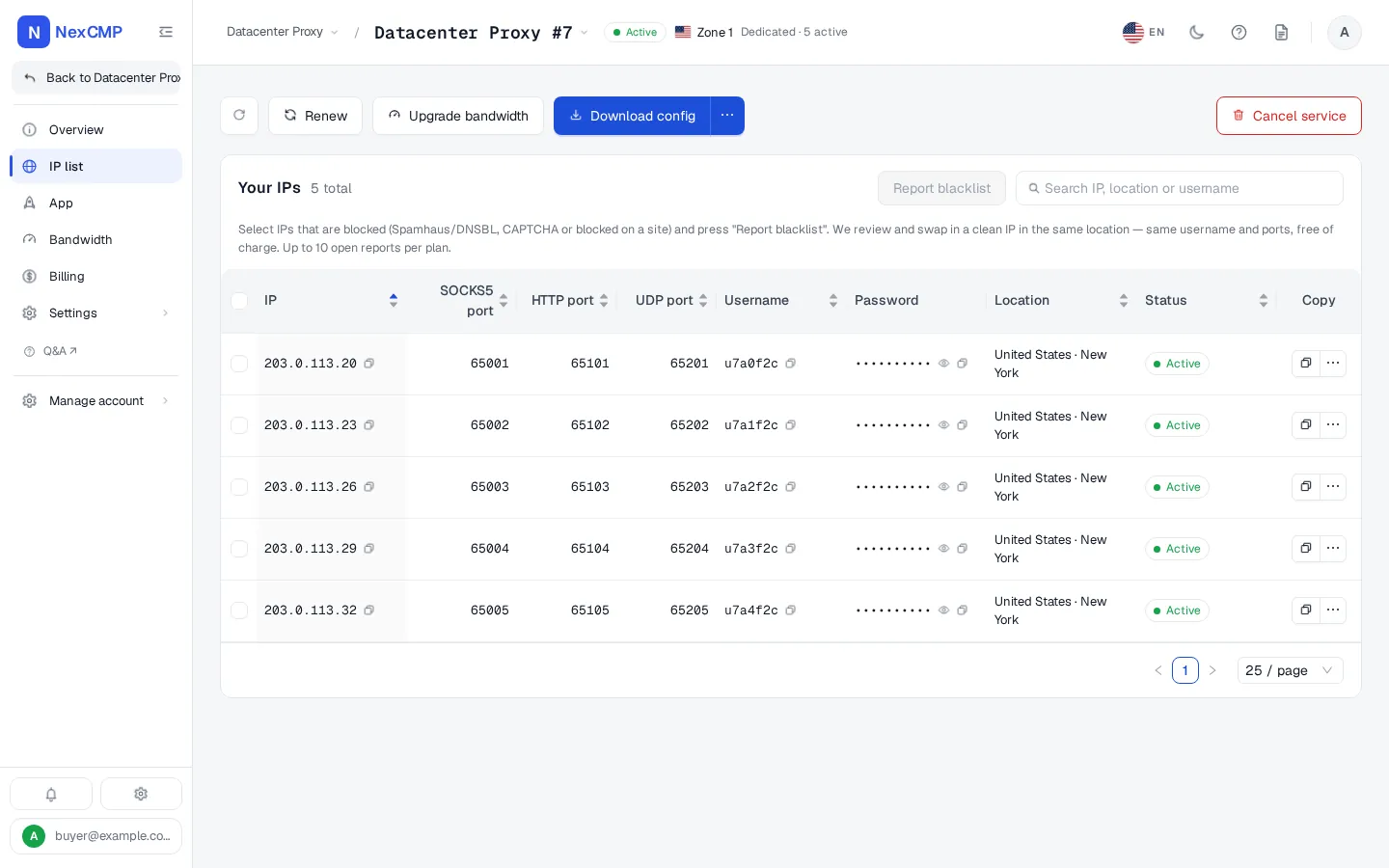
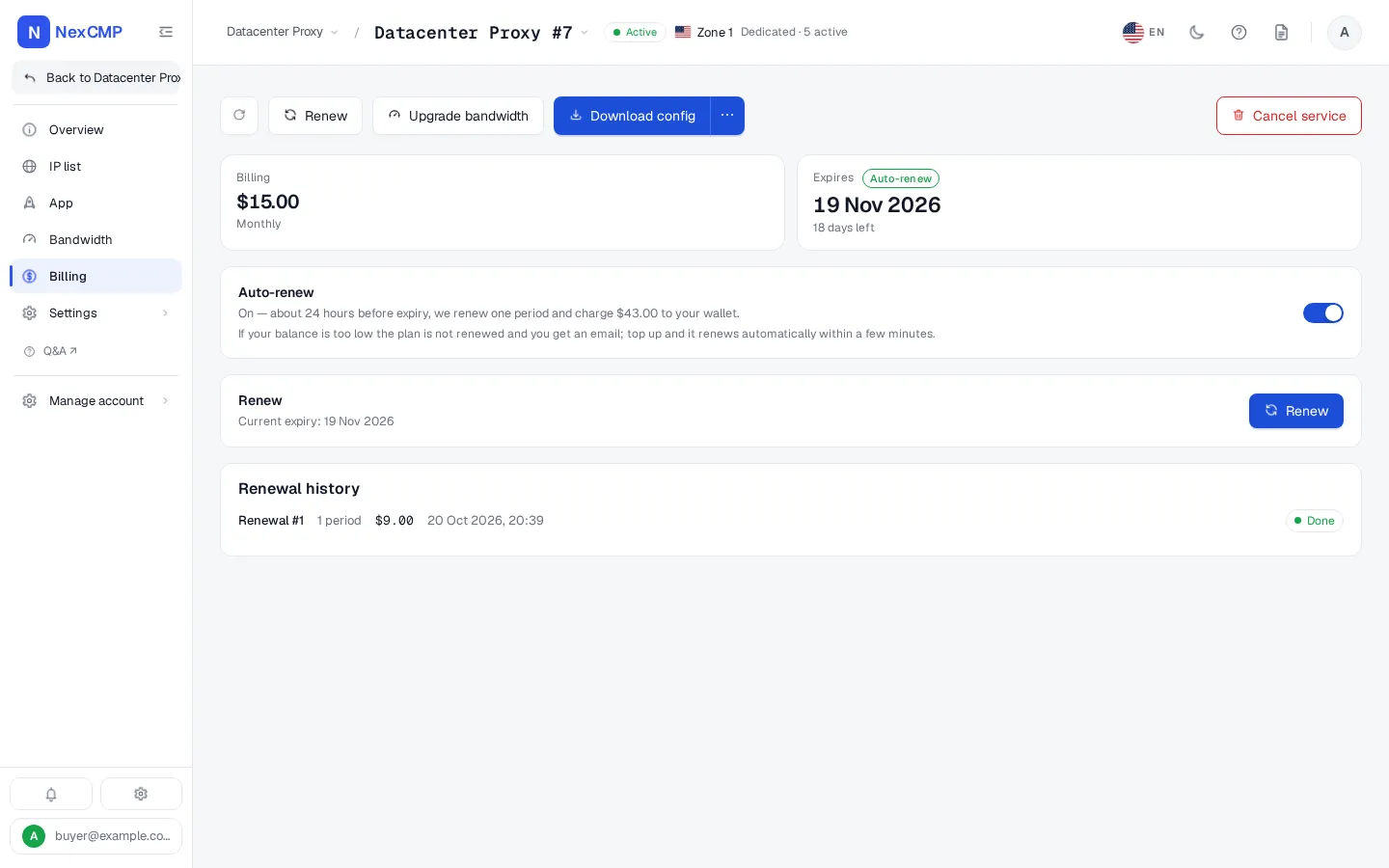
Every screen is a tab of the service page in the customer portal, shown with sample data. Pick a tab, use the arrows or the left and right keys, or open the full-screen viewer.
IPv4 plan
IPv4 IP list
IPv4 billing
IPv6 plan
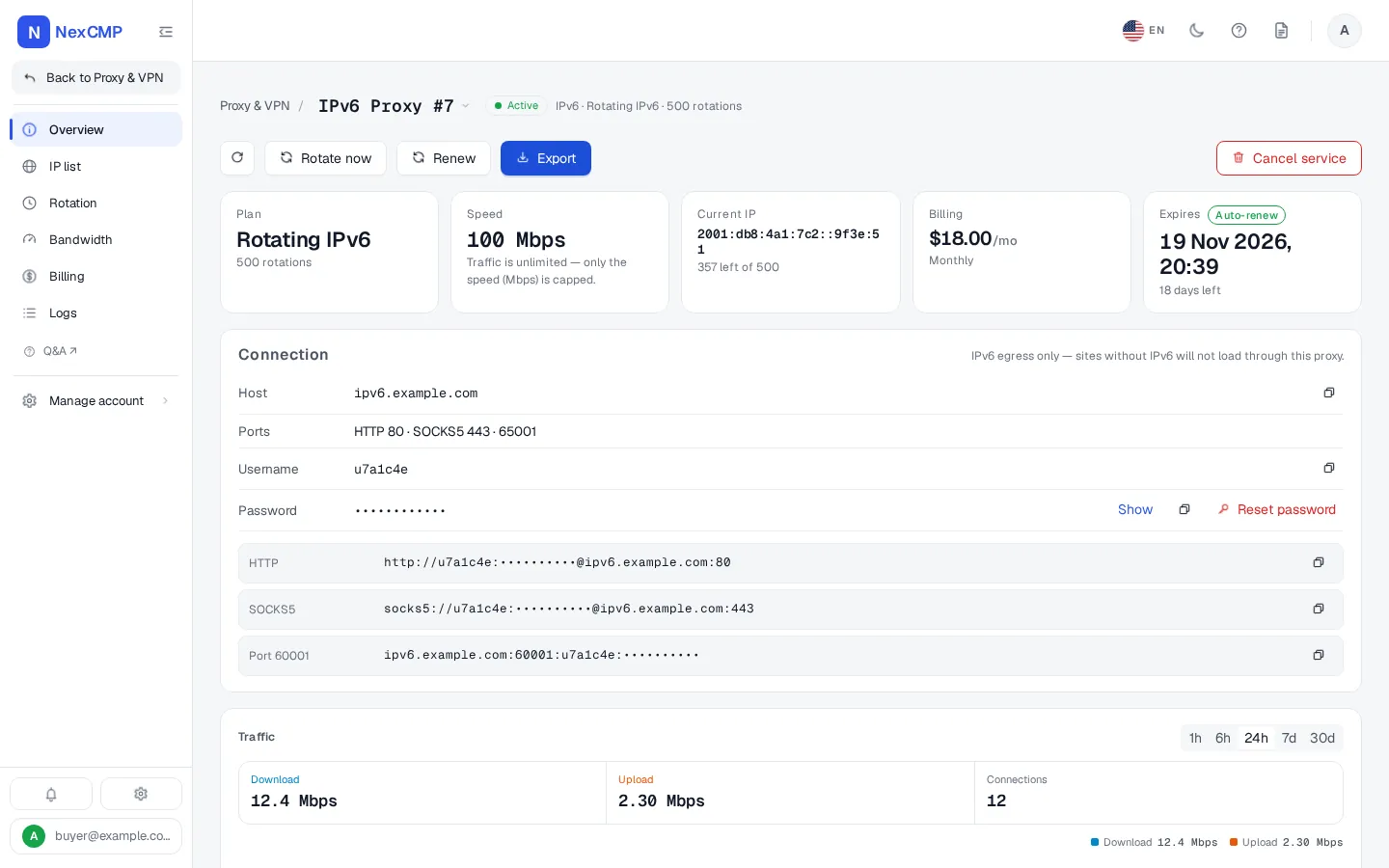
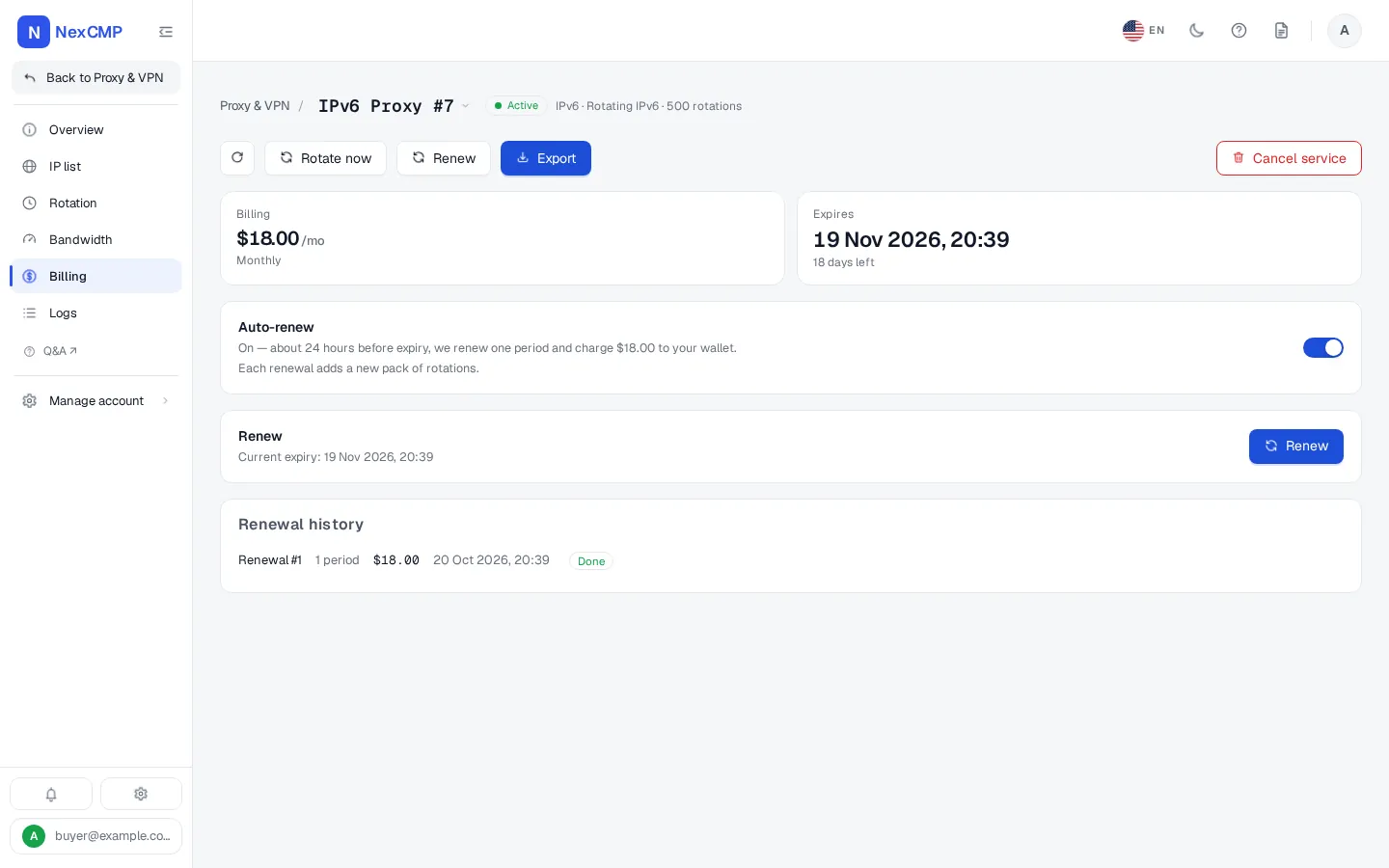
IPv6 rotation
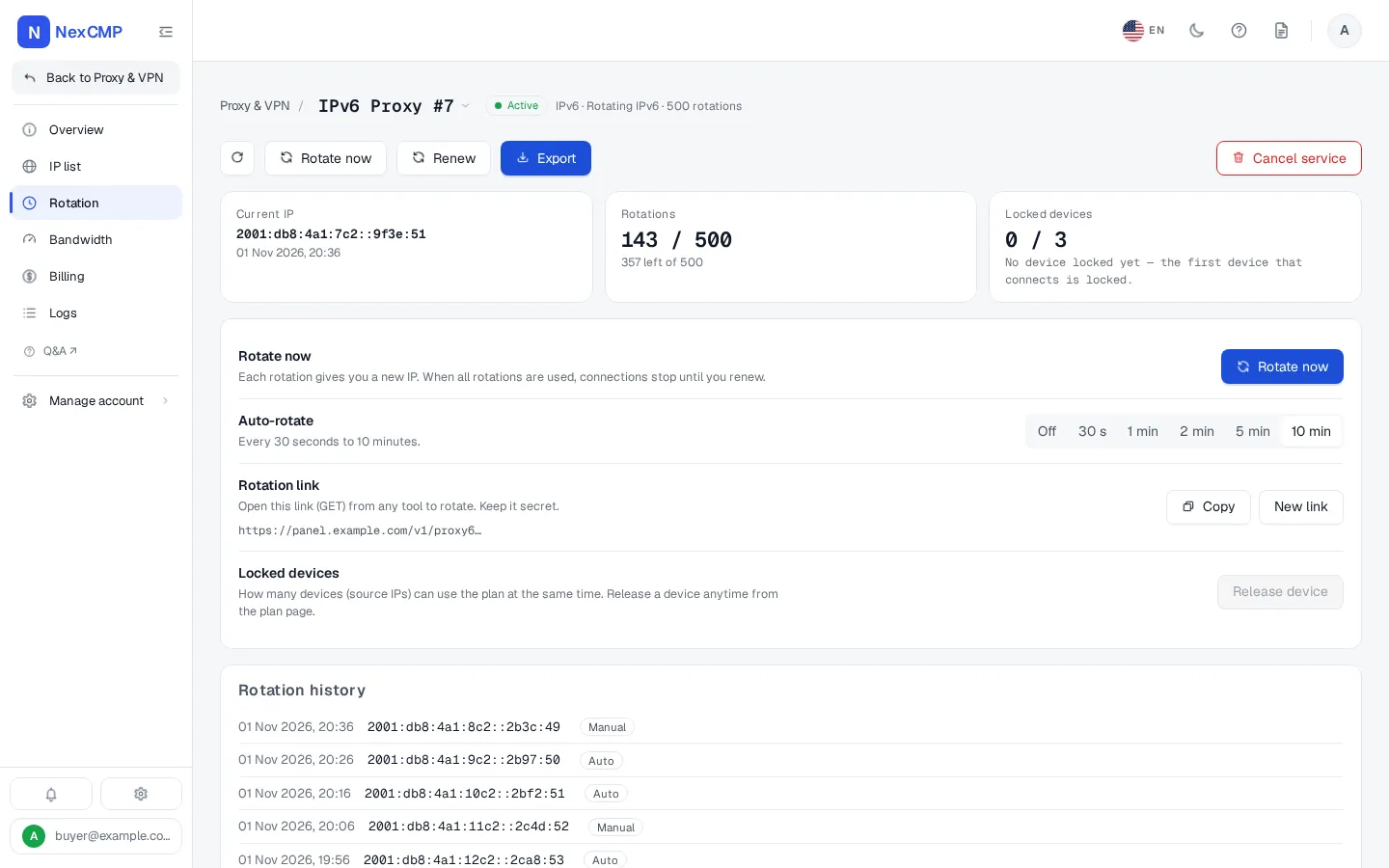
IPv6 billing
What you need to run a proxy business
NexCMP covers the software parts; the rest is yours.
- IP addresses or a subnet that you are entitled to use and route. The source of every address is your responsibility.
- Nodes. Linux x86_64 servers that hold the addresses or receive a routed prefix. NexCMP installs and monitors the agent.
- Billing. Plans, cycles, a wallet, invoices, payment gateways, renewals and quotas. This is what NexCMP does.
- Support. The ticket system is in NexCMP; the people are yours.
- An acceptable-use policy and a way to handle abuse reports. You write and enforce them.
Four kinds of product you can sell
Each one is described on its own. A single NexCMP install can offer any of them.
Datacenter IPv4 proxies
Dedicated IPv4 addresses from your own subnets, each with SOCKS5 and HTTP ports and its own user name and password. Sold per IP from the VPN module.
Static residential and ISP proxies on your own IPs
Static residential or ISP addresses you already hold, sold as dedicated IPs. NexCMP bills and manages them. It includes no residential network and no peer or backconnect network.
IPv6 proxies
Static, rotating and no-data-cap plans (speed-limited in Mbps) in the IPv6 Proxy module, served from a routed IPv6 prefix on your nodes.
VPN-style access
SOCKS5, HTTP and UDP access on your IPv4 addresses, with subscription links and QR codes. No WireGuard or OpenVPN tunnels and no branded client apps.
How the pieces fit together
Customers use the portal. The panel holds the business logic. The proxy ports run on your nodes.
Node management and setup
Nodes are added and watched from the admin console.
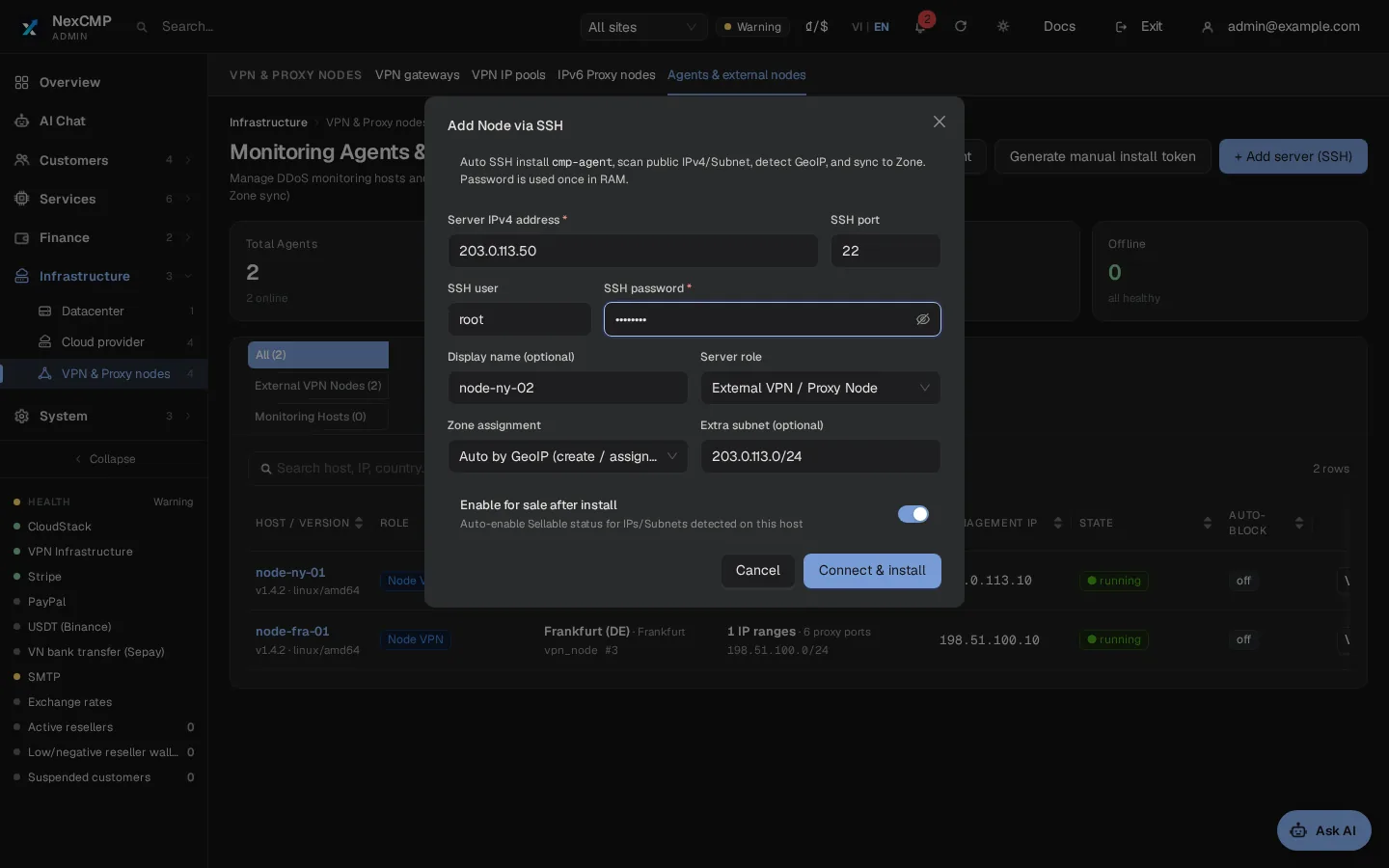
Install a node over SSH
Enter the node's public IPv4, SSH port, user and password, a name and a zone. The panel installs the agent over SSH.
Heartbeat, status and IP pool
A VPN node reports every 5 seconds and shows online within 60 seconds of its last report. The agent finds the server's public IPv4 addresses and any extra subnets you list, and they become sellable IPs. The node's own gateway address is never sold.
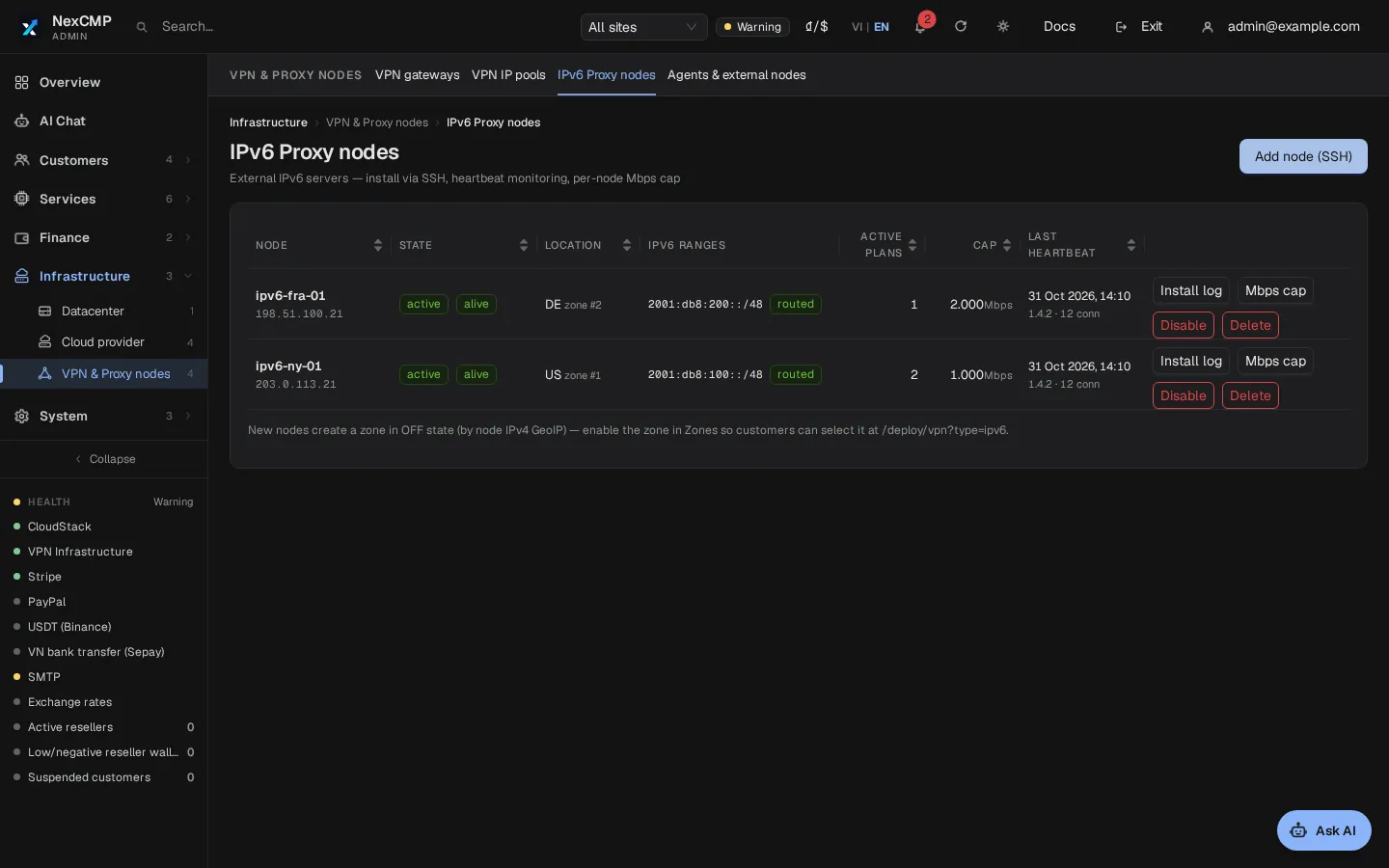
IPv6 nodes
Add an IPv6 node over SSH with a total speed cap in Mbps and a reason. The installer probes the IPv6 prefix. A zone it creates stays off until you enable it.
Plans and pricing
You set every price. NexCMP's sample prices are only a starting point.
Dedicated IPv4 price list
The VPN price list sells dedicated IPs. The price per IP falls by quantity band, and the band reached applies to the whole order. Bandwidth tiers and add-ons are priced separately.
IPv6 plans
Static (a number of IPs), rotate (a number of rotations per period) and no data cap, speed-limited in Mbps. Add-ons add speed in steps of 50 Mbps and, on no-data-cap plans, devices.
Billing cycles
Daily, weekly, monthly and yearly. A new price applies to new orders only; sold subscriptions keep their price. Cancelling ends a service at once, with no refund of the unused term.
Renewals
Auto-renew is on by default and charges the wallet before the term ends; a short wallet notifies the customer. An expired VPN subscription keeps its IPs for a 3-day grace period.
Bandwidth and limits
Limits are defined per product. This is exactly what each module does.
IPv6 Proxy: speed in Mbps
Each plan has a speed limit in Mbps, applied in both directions. A total cap on each node and an add-on of +50 Mbps per unit adjust it. There is no GB quota on IPv6 Proxy plans.
VPN module: a measured data allowance
Plans have a data tier in GB per period, and customers can upgrade it mid-term by paying the difference for the days left. From NexCMP 1.5.1 the panel adds up the traffic reported by the node agent and cuts the plan when the GB are used up, then opens it again within seconds after an upgrade or a new period. For a hard speed cap, sell IPv6 Proxy plans.
Blocked mail ports
The VPN module blocks outbound port 25. The IPv6 Proxy module blocks 25, 465, 587 and 2525, reaches only websites that have an IPv6 address, and carries TCP only. No setting opens these ports.
Quotas per customer
Quotas limit how many IPs one customer can hold: vpn.ips for the VPN module and proxy6.ips for the IPv6 Proxy module. Defaults follow the customer's top-up tier, and the check runs before the wallet is charged.
Quotas are off by default. When you switch them on, you set the default per tier and can override one customer; an override needs a reason and is audited.
IP rotation
Rotation exists for IPv6 only. A customer rotates by hand in the portal or API, calls a public rotation link, or sets a schedule of 30 to 600 seconds. Rotate plans count rotations; no-data-cap plans do not, and an old address is not reused for 24 hours.
IPv4 proxies do not rotate. If an IPv4 address is blacklisted, the customer reports it, NexCMP checks DNS blocklists, and an administrator approves a free replacement from the same zone that is not listed. It keeps the user name, password and ports.
Authentication: user/pass and IP auth
VPN module: SOCKS5 (with UDP associate), HTTP and UDP on ports 65001 to 65535. IPv6 Proxy: HTTP on port 80, SOCKS5 on port 443, and ports from 60001 for static IPs. Each module authenticates its own way.
VPN module: user/pass and authorized IPs
Every IP has its own user name and password. Customers can also list authorized source IPs that connect without a password: 3 by default, 1,000 with an add-on.
IPv6 Proxy: user/pass and device lock
A user name and password the customer can reset, and a device lock by source IP: 1 device on rotate plans, 1 plus add-ons on no-data-cap plans. The customer or you can release a device. There is no IP allow-list.
Export and API
IPv6 Proxy exports hostport, userpass, socks5, http, ips, clash and singbox. The VPN module exports socks, http, plain lines, json, clash, singbox and v2rayn, with a subscription link the customer can change and a QR code.
Customer API keys carry scopes: vpn:read, vpn:detail, vpn:write, vpn:create and vpn:destroy. Buying through the API charges the wallet and needs an idempotency key. An OpenAPI description and the cmp command-line tool cover the same calls.
NexCMP proxy screens
Screenshots of a lab install with sample data, not real infrastructure or customers.
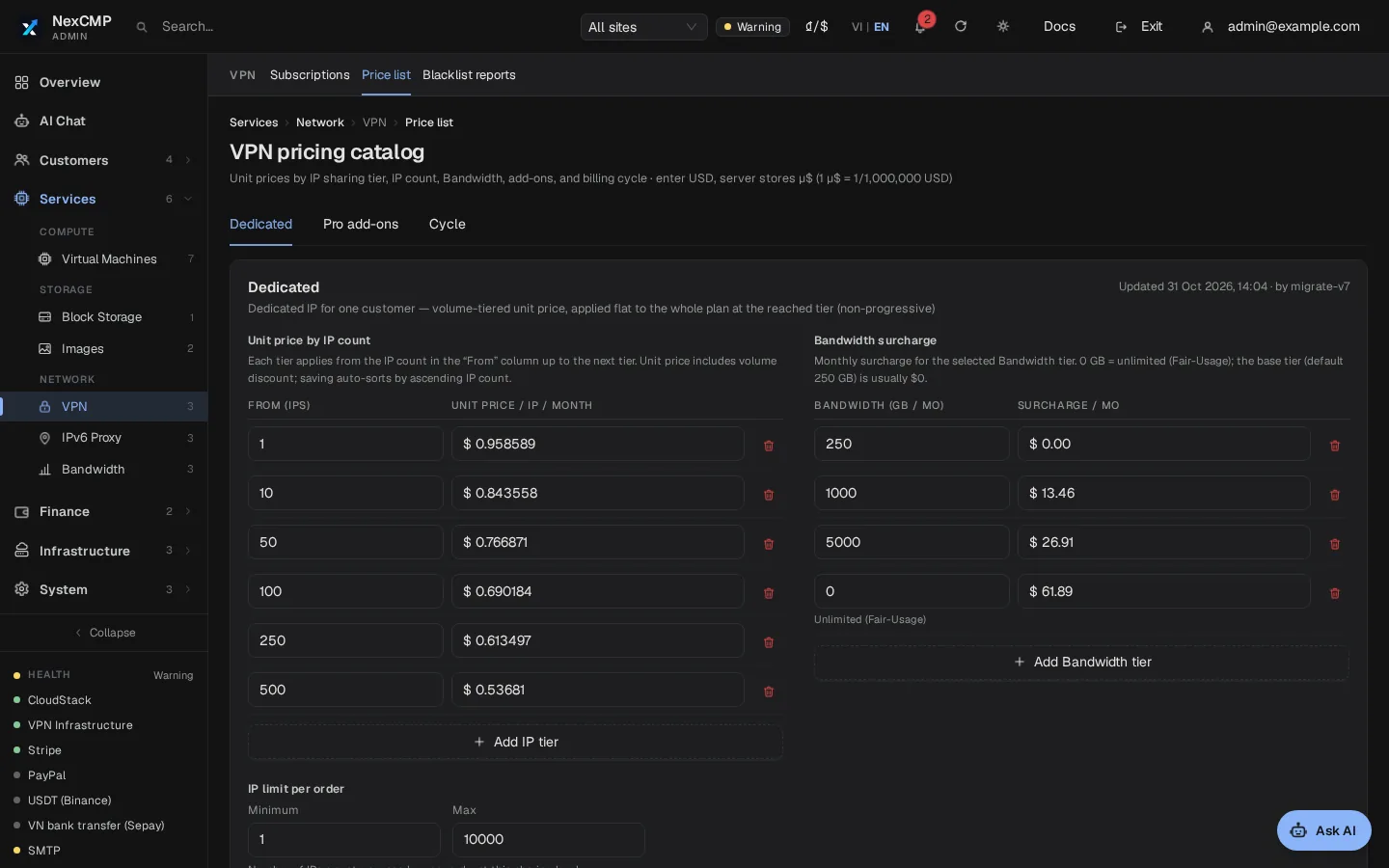
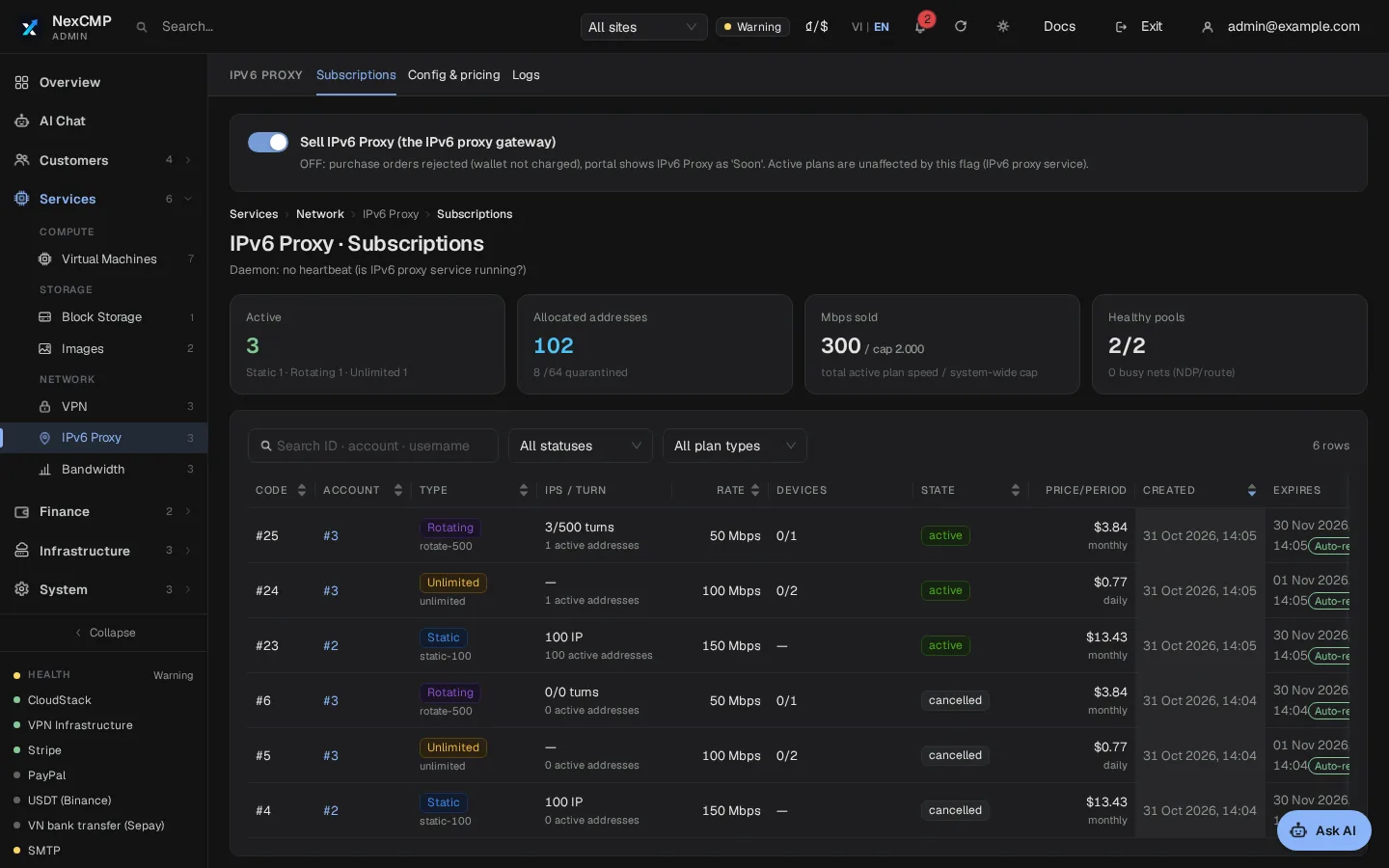
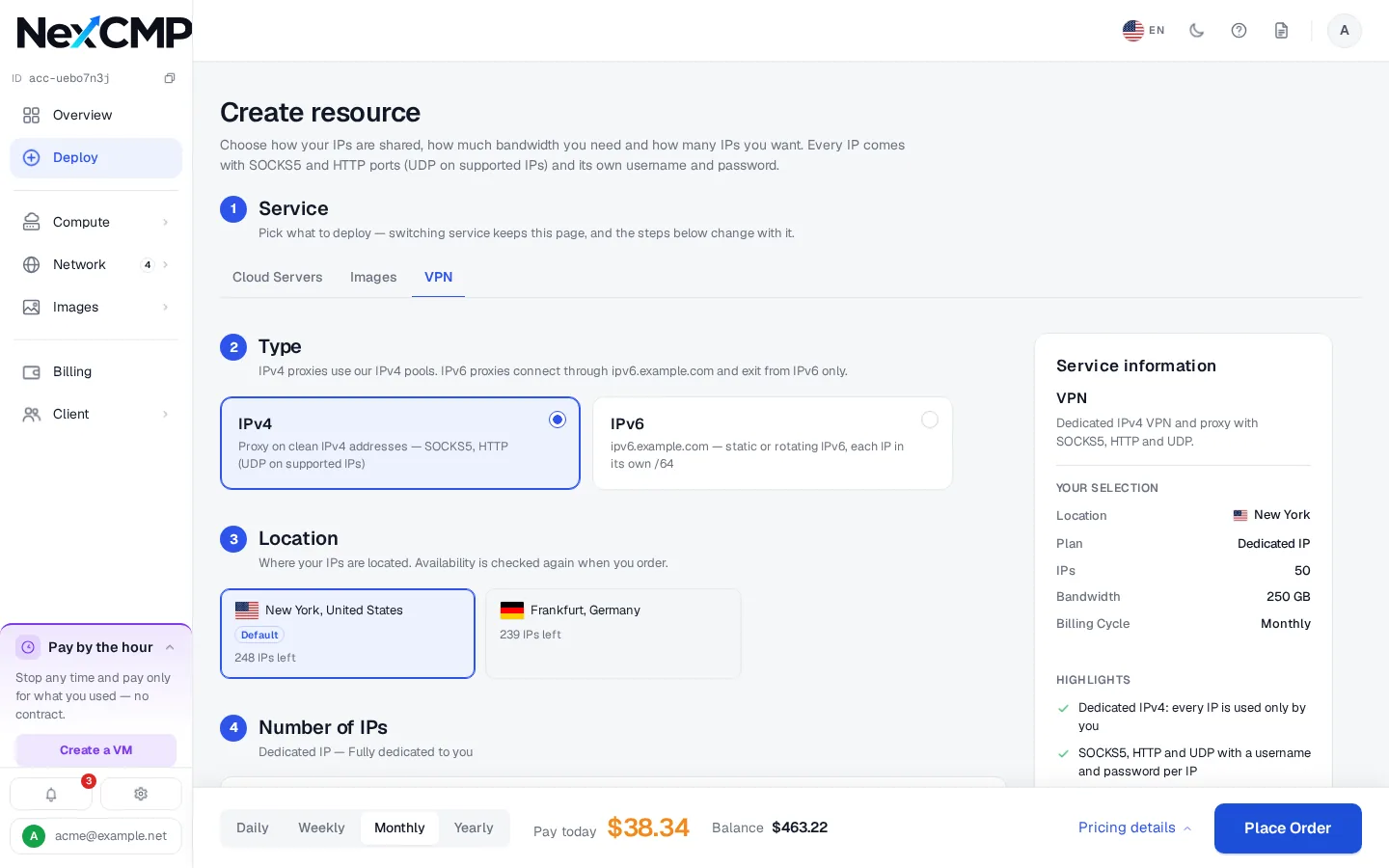
What your customers can do
Each item is something a customer does in the portal or through the API with a scoped key. IPv6 Proxy also keeps a searchable 30-day connection log.
Order
Choose a zone, quantity, add-ons and cycle, see the quote, and pay from the wallet. If no IP can be allocated, nothing is charged.
Manage access
Edit authorized IPs (VPN module); reset the password and release a locked device (IPv6 Proxy).
Rotate
Rotate IPv6 proxies now, set a schedule, or use a public link that can be changed at any time.
Report a blacklisted IP
Pick the IPs, say why, and get a replacement once an administrator approves it.
Upgrade and add on
Raise the VPN data tier mid-term, add add-ons (charged now) or remove them (from next term).
Renew or cancel
Renew in advance, switch auto-renew on or off, cancel, or transfer a VPN subscription to another account.
What you can do as the operator
Each item is in the NexCMP admin console. Price, quota and IPv6 node changes ask for a reason and go to the audit log. Both modules are switched on under License & updates.
Run nodes and IP pools
Add nodes, edit their ranges and zones, and mark ranges as sellable or not.
Set prices
Edit the VPN price list and the IPv6 Proxy plans, add-ons and cycles.
Handle blacklist reports
Approve a replacement IP, or reject the report with a reason sent to the customer.
Set quotas
Set defaults per top-up tier and override a customer with a reason.
Name the product
Set the service name in Admin > Settings > Branding, for example IPv4 Proxy or Datacenter Proxy. It changes only the label.
Work with resellers
Give each reseller the Sell VPN and Sell IPv6 Proxy switches. Resellers approve blacklist reports for their own customers.
Infrastructure requirements
You run the servers and own the addresses. The full list, with the exact steps, is in the docs at https://nexcmp.com/docs/infrastructure/vpn-proxy-nodes/.
- VPN nodes: Linux x86_64 with systemd, root access for the install, and HTTPS from the node to your panel.
- VPN addresses: public IPv4 addresses on the server, or a prefix routed to it. Customers reach each IP on TCP and UDP ports 65001 to 65535.
- IPv6 nodes: Linux x86_64 with systemd, ports 80, 443 and everything above 60000 free, and an IPv6 prefix from /32 to /64 that is routed to the node or on-link.
- In a routed IPv6 prefix each address sold gets its own /64, so you need as many /64s as addresses sold at once; on a single on-link /64 each address sold is one /128 inside it. The node also needs a public IPv4 address and HTTPS access to your panel.
Fit check
NexCMP fits you if you hold IP addresses, run Linux servers, and want to sell dedicated IPv4, static residential or ISP, or IPv6 proxies with billing, quotas and an API on your own domain.
NexCMP does not fit if you need IPs or bandwidth supplied to you, a peer or backconnect network, WireGuard or OpenVPN tunnels, or branded client apps.
Responsibility: you are responsible for where your IP addresses come from, for obeying the laws that apply to you, and for the acceptable-use policy you give your customers. NexCMP does not provide IPs or bandwidth, and nothing on this page is legal advice.
Choose your product
Free and Source
The VPN and IPv6 Proxy modules are in NexCMP Free and NexCMP Source. Free is $0 for the first year, then $99 per year, for operators with their own ASN and a subnet in their own name; applications are reviewed. Source is a $499 one-time purchase. Servers, IPs and prefixes are yours.
The slides above show the customer portal before you decide.
Proxy billing: frequently asked
What is proxy billing software?
Does NexCMP provide proxies, IPs or bandwidth?
What do I need to start selling proxies?
Which proxy products can I sell?
How are plans limited?
Can customers authenticate with user/pass and IP?
Can I export proxy lists through an API?
Who is responsible for acceptable use?
Is it self-hosted, and can I try it?
Sources
NexCMP documentation for proxy and VPN nodes.
Get NexCMP free
Free, with the VPN and IPv6 Proxy modules and every other module included. Install it on your server today, or look at the customer portal screens first.

Last updated: