Guide
Open Source CloudStack billing: software, metering and source code
CloudStack billing turns what customers use on Apache CloudStack — virtual machines, storage, IPs, traffic — into prices, invoices and payments. NexCMP is a self-hosted CloudStack billing and customer portal platform that does it for free.
Updated 30 October 2026. Third-party facts come from the vendors' own pages, read on 2026-10-19.NexCMP Source: full source code for $499, one-time. Use, modify and self-host for your own business. You may sell the services you operate; you may not resell or redistribute the source code or builds. Source license terms


What is CloudStack billing?
CloudStack billing is the layer that prices and charges what customers consume on Apache CloudStack: virtual machine hours, disks, public IPs, snapshots, backups and network traffic. It covers metering, rating, a customer wallet or credit, invoices and payment gateways and, for providers who sell through partners, reseller billing.
The CloudStack Usage Server is “an optional, separately-installed part of CloudStack” that turns event data into summary usage records (running VM, allocated VM, IP address, network bytes, volume, template, snapshot and more), retrieved through the listUsageRecords API. CloudStack’s documentation describes those records as the basis for a billing integration you build on top.
Pricing, invoices, payments and a branded storefront are the job of a billing layer on top of CloudStack — which is why providers add one.
What your customers see of their bill
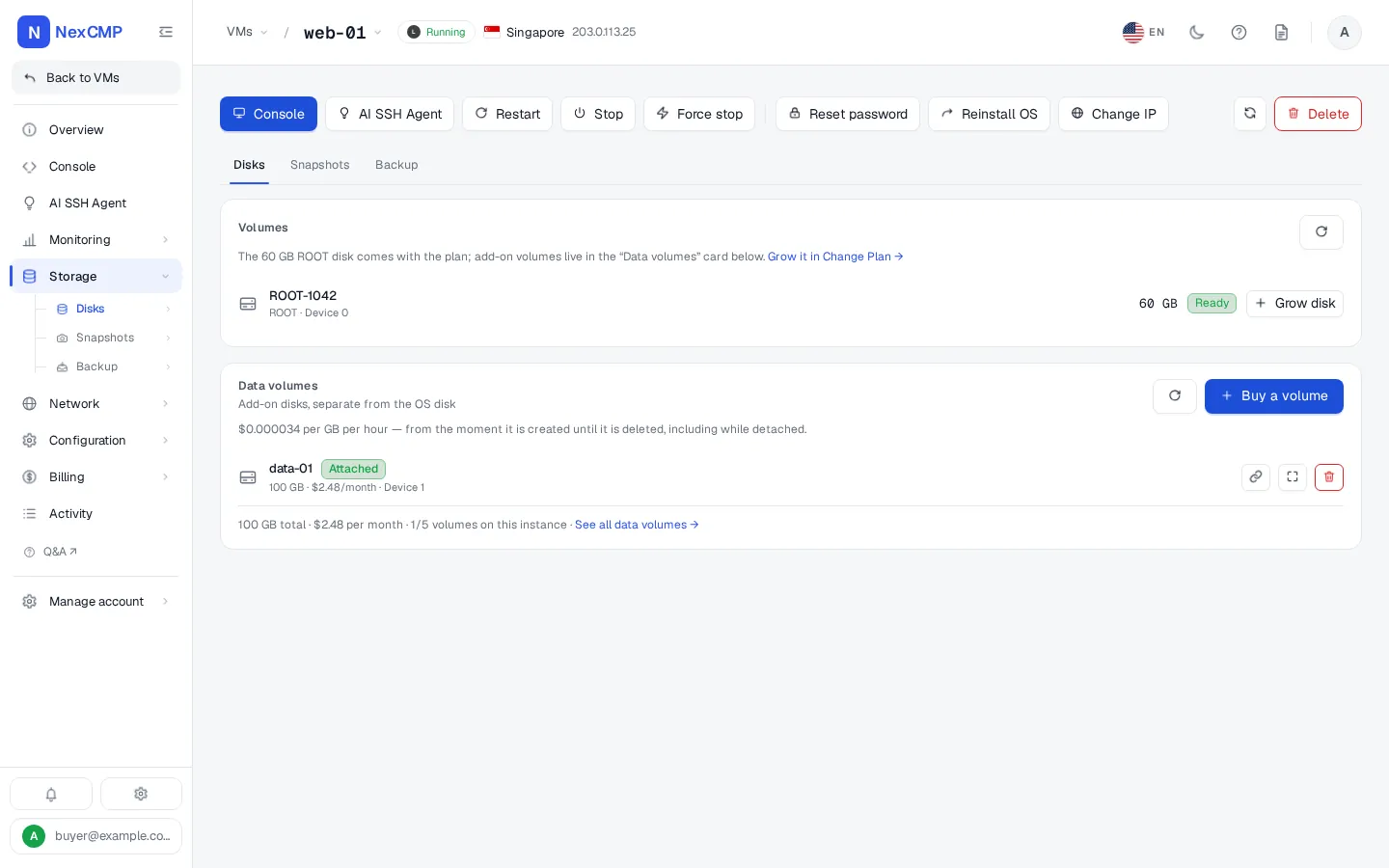
The virtual machine page in the customer portal carries the billing: the plan and cycle, the renewal and the history. Pick a tab, use the arrows, or open the full-screen viewer. Screens show sample data.
Overview
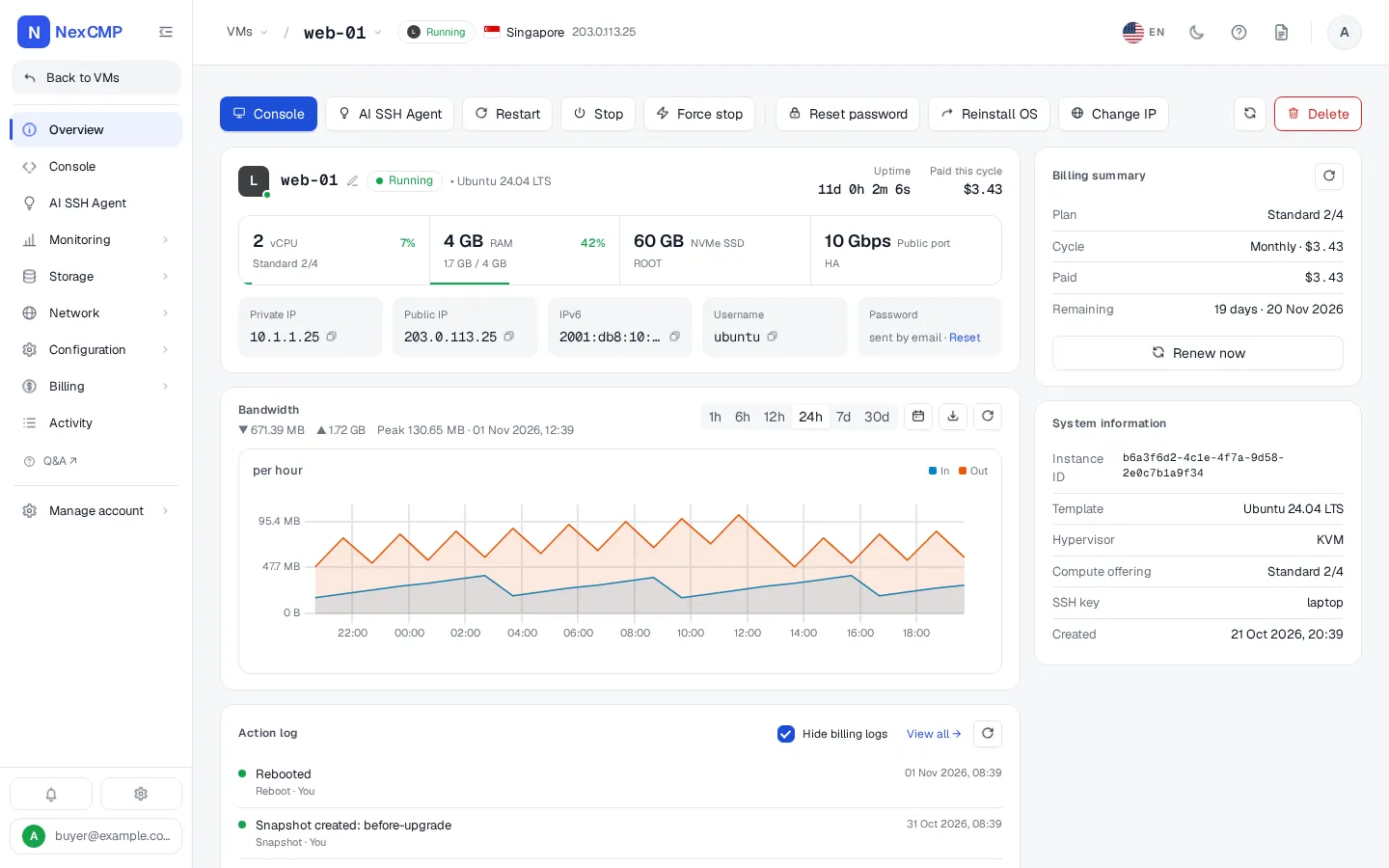
Billing
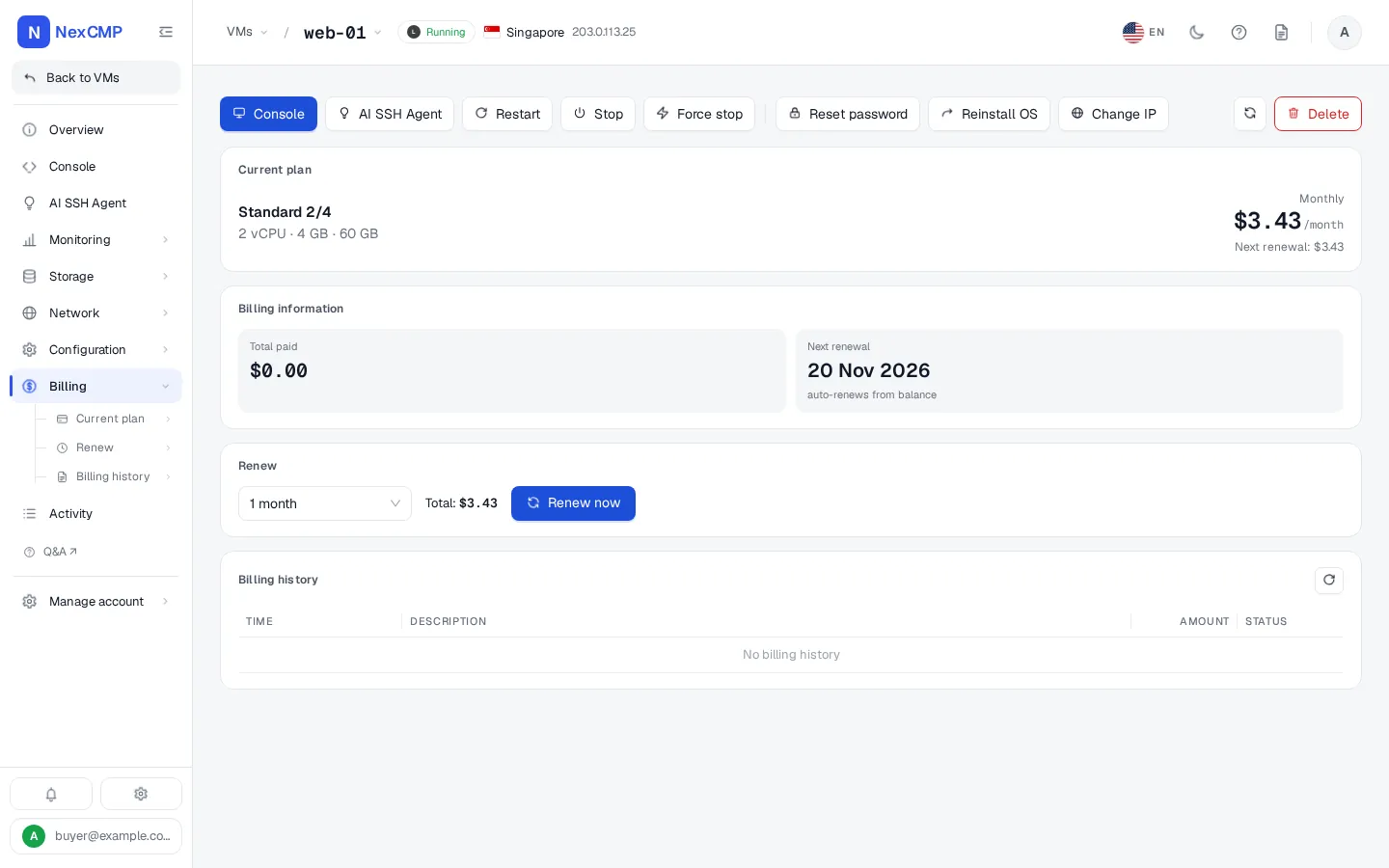
Change plan
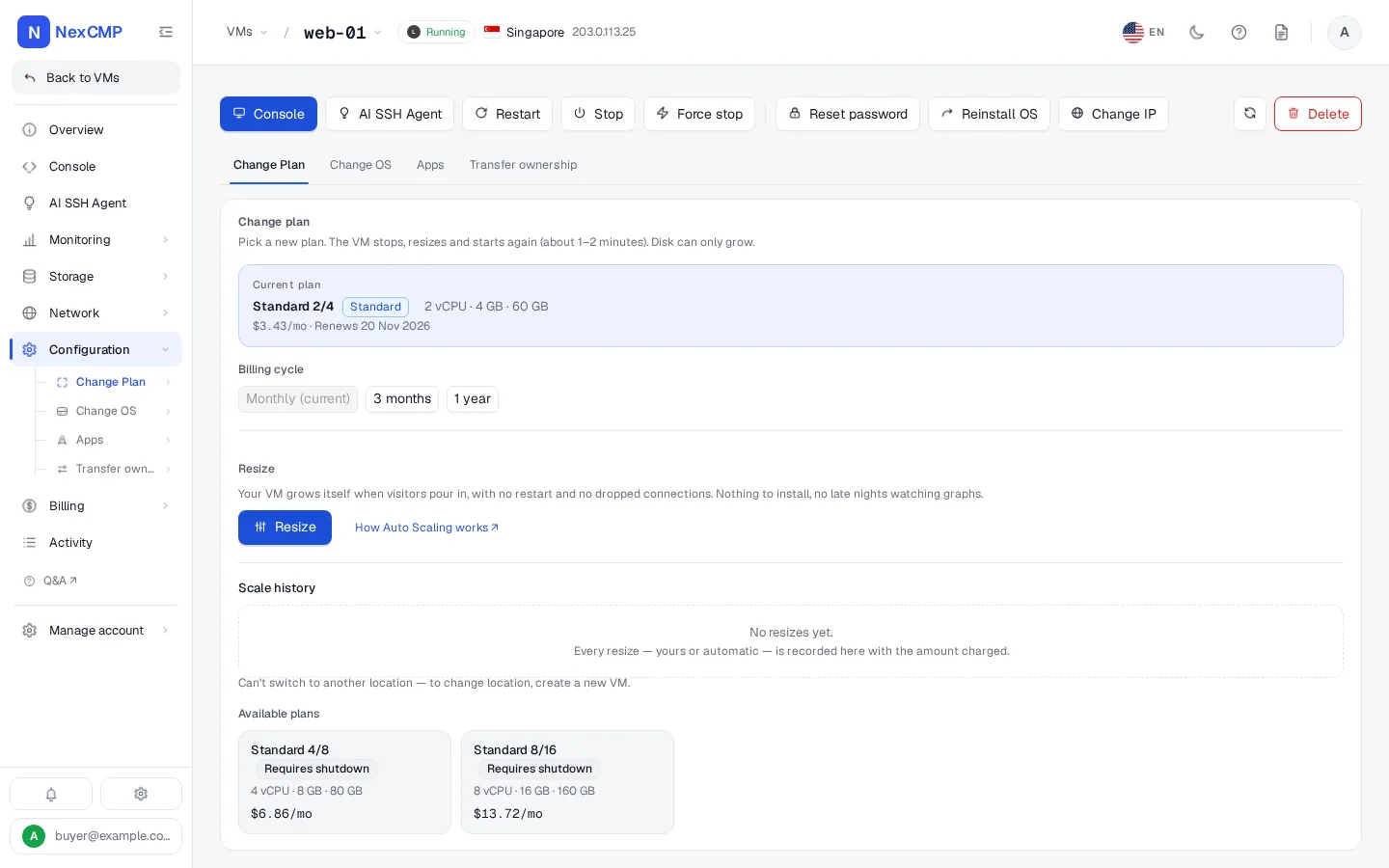
Activity
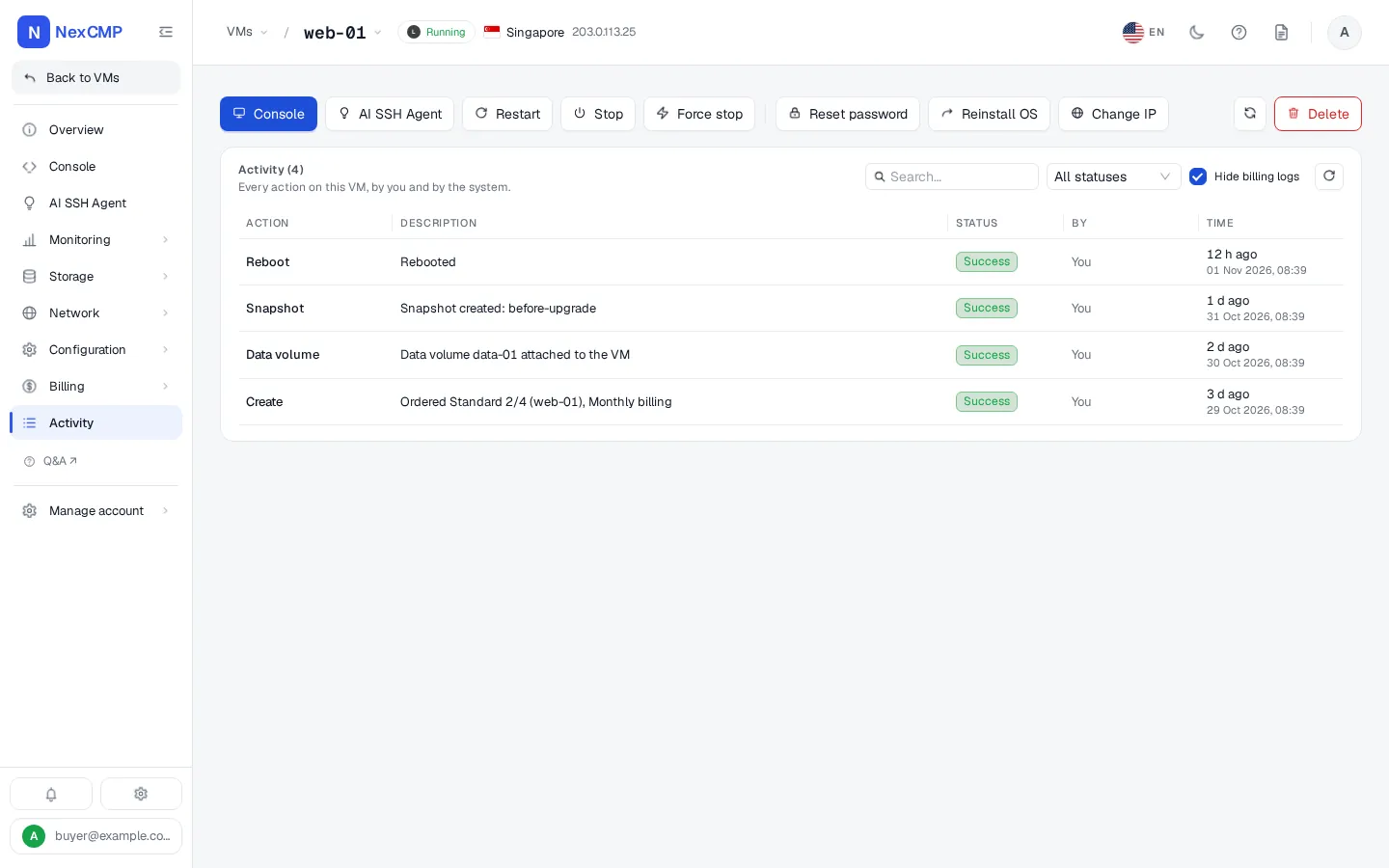
Storage
How do providers bill CloudStack customers today?
There are four common routes. The right one depends on how much you want to build, what else you sell and who runs the software.
- Build it yourself on the Usage Server records. No license cost, but you write the rating, invoicing, payment and portal code.
- Add a CloudStack module to a general billing system. HostBill ships a CloudStack module that bills hourly VM usage or metered resources, Ubersmith documents a CloudStack billing service module, and WHMCS's marketplace lists one third-party CloudStack module.
- Use a cloud management portal built for CloudStack. StackBill, now part of StackOrbit, is one; it prices per physical hypervisor node and does not publish an amount.
- Install a self-hosted CloudStack billing and customer portal build. That is NexCMP: one license, no per-node, per-VM or per-customer fee.
What should a CloudStack billing system cover?
Use this checklist to compare any option, NexCMP included.
Metering and rating
- What it means
- Price every VM, volume, IP, backup and GB of traffic customers use.
- How NexCMP covers it
- VMs are charged by the hour or the month; data volumes and backups by GB-hour; traffic is read from CloudStack's VM statistics and feeds quotas, add-on packs and alerts.
Prepaid wallet or credit
- What it means
- Customers fund an account and are charged as they consume.
- How NexCMP covers it
- A prepaid wallet on an append-only, double-entry ledger — a balance is the sum of immutable rows, never a number edited in place.
Invoices and payments
- What it means
- An invoice for every charge and top-up, and gateways customers can pay through.
- How NexCMP covers it
- Automatic invoices with a printable view; Stripe, PayPal, USDT (TRC20) and SePay bank transfer — you connect your own accounts.
Customer self-service portal
- What it means
- Customers order, control and watch their own servers.
- How NexCMP covers it
- Deploy, power actions, resize, reinstall, browser console, snapshots, backups, data volumes, public IPv4 and a self-service firewall.
Resellers and white-label
- What it means
- Partners sell under their own brand and prices.
- How NexCMP covers it
- Each reseller gets its own domain, brand, retail prices and wholesale wallet; reseller domains are unlimited; NexCMP Free covers 1 primary domain.
Quotas and limits
- What it means
- Stop customers running more than they have paid for.
- How NexCMP covers it
- Deposit-based quotas, enforced whenever a VM is created, resized or given more storage.
API
- What it means
- Let customers and partners automate.
- How NexCMP covers it
- A public REST API with scoped, revocable API keys and an OpenAPI document.
How does NexCMP bill a CloudStack customer?
From top-up to invoice, in the order it happens:
The customer funds the wallet
A card, PayPal, USDT or bank-transfer payment, or a voucher code, adds a row to the ledger and creates an invoice.
The customer orders a server
They pick a plan and an OS in the portal and see the price before they confirm. NexCMP provisions the VM on your CloudStack through its API.
NexCMP charges as the VM runs
Each VM is charged by the hour or the month against the wallet. Data volumes and backups are charged by GB-hour, and traffic is checked against quotas.
Resellers settle against wholesale
A sale through a reseller charges the customer at the reseller's retail price and settles the wholesale cost against the reseller's wallet automatically.
Example: in the NexCMP demo a 1 vCPU / 2 GB plan is priced at $0.005 per hour — $3.60 over 30 days. It is a demo catalog price; you set your own.
What do you need to run NexCMP on CloudStack?
NexCMP keeps its own hourly ledger, and the CloudStack Usage Server is not on its list of requirements. Once you have your free license, your account page shows your license key and the exact install command:
- An Ubuntu 22.04 or 24.04 x86_64 server with at least 2 GB of RAM, and a domain.
- An Apache CloudStack that server can reach through its API — NexCMP is developed and tested against CloudStack 4.23.
- The API URL and keys of a CloudStack account that owns the VMs you sell, plus compute offerings, templates, a network and a pool of public IPs.
- Optional CloudStack features only for optional modules: Backup & Recovery for backups, Kubernetes Service for Kubernetes, VPC offerings for Private Cloud.
curl -fsSL https://nexcmp.com/install.sh | sudo bash -s -- \
  --license <LICENSE_KEY> --domain <YOUR_DOMAIN> --port 3000
How much does CloudStack billing software cost?
Published prices, read from each vendor's own pages on 2026-10-19. Prices exclude tax, and vendors change them — check before you buy.
NexCMP
- Published price
- Free ($0) for the first year with every module and unlimited reseller domains, then $99 per year; NexCMP Source adds the full source code, all apps and 30 working days with an expert for $499 one-time.
Source: nexcmp.com/pricing · accessed 2026-10-19
HostBill CloudStack module
- Published price
- Included in the Enterprise, Data Center and All-Inclusive editions; a standalone price of $299 (Standard) or $499 (Developer, with source code) was listed on 2026-10-19 but is no longer shown on the page.
Source: hostbillapp.com — CloudStack module · accessed 2026-10-30
HostBill editions
- Published price
- Startup $599 · Enterprise $999 · Data Center $1,599 · All-Inclusive $5,999 — one-time, each with 1 year of updates.
Source: hostbillapp.com/pricing · accessed 2026-10-30
WHMCS
- Published price
- From $34.95/month (Plus, up to 250 active clients). One third-party CloudStack module in the WHMCS Marketplace ($45.00, last updated December 2022).
Source: whmcs.com/pricing · accessed 2026-10-30
StackBill (StackOrbit)
- Published price
- Monthly by physical hypervisor node; no amount published. StackOrbit lists a perpetual license with a 10-host minimum and 20% annual maintenance, by quote.
Source: stackbill.com/pricing.html · accessed 2026-10-30
Ubersmith CloudStack module
- Published price
- Documented; price not published.
Source: Ubersmith docs — Configuring CloudStack Billing Service Module · accessed 2026-10-19
How does NexCMP compare with StackBill and WHMCS?
Each comparison lists what the vendors publish, with sources and dates:
CloudStack billing — frequently asked questions
What is CloudStack billing software?
Does Apache CloudStack include billing?
Can CloudStack VMs be billed by the hour?
Does NexCMP need the CloudStack Usage Server?
Can resellers have their own branded portal?
How much does NexCMP cost?
Which CloudStack versions work?
Can I try it before buying?
Sources
Pages read on 2026-10-19. Vendors change their pages; check them before you decide.
- Apache CloudStack docs — Usage
- hostbillapp.com — CloudStack module
- hostbillapp.com/pricing
- HostBill docs — metered billing for CloudStack
- whmcs.com/pricing
- WHMCS Marketplace — Apache CloudStack Automation for WHMCS
- stackbill.com/pricing.html
- stackorbit.com/pricing
- Ubersmith docs — Configuring CloudStack Billing Service Module
Get CloudStack billing running today
Free for the first year, every module included. Install it on your server with one command.